Satellite TV or Streaming? Why the Smartest Hotels Are Choosing Both
The in-room entertainment decision that’s shaping guest reviews — and what property managers need to know before their next upgrade cycle.
There was a time when the in-room television was a simple checkbox. Put a TV in the room, connect it to cable/satellite TV, and move on. That era is over.
Today’s hotel guest arrives with a streaming subscription in their pocket, an expectation of seamless connectivity, and, if your setup falls short, a willingness to say so publicly in a review. The entertainment system in a guest room is no longer background noise. It is part of the experience your property is being judged on.
So when it comes to the satellite TV vs. streaming debate, the question most hospitality operators are asking is the wrong one. The right question isn’t which one — it’s how do you deliver both in a way that actually works at scale?
What Satellite TV Still Gets Right
Despite the consumer shift toward on-demand content, satellite TV remains the backbone of reliable hospitality entertainment for good reason.
Live content, news, sports, and local programming are still consumed in real time by a significant portion of guests. A traveler checking into a hotel during a major sporting event or a breaking news cycle isn’t looking for a Netflix menu. They want to turn on the TV and find it. Satellite TV and DIRECTV bulk agreements deliver that consistency with a level of reliability that internet-dependent solutions simply cannot match during peak usage hours.
There’s also the operational side. With a properly structured bulk agreement, property managers get predictable monthly costs, one point of contact for support, and a channel lineup that doesn’t change without notice. For a 200-room hotel managing dozens of operational variables at once, that kind of stability has real value.
What Streaming Brings to the Modern Guest Room
The gap between what guests experience at home and what they find in a hotel room has narrowed, and in some cases, reversed. Guests who watch content through personal subscriptions on their smart TVs at home increasingly expect to access that same content when they travel. If they can’t, it registers as a friction point, even if they don’t consciously identify it that way.
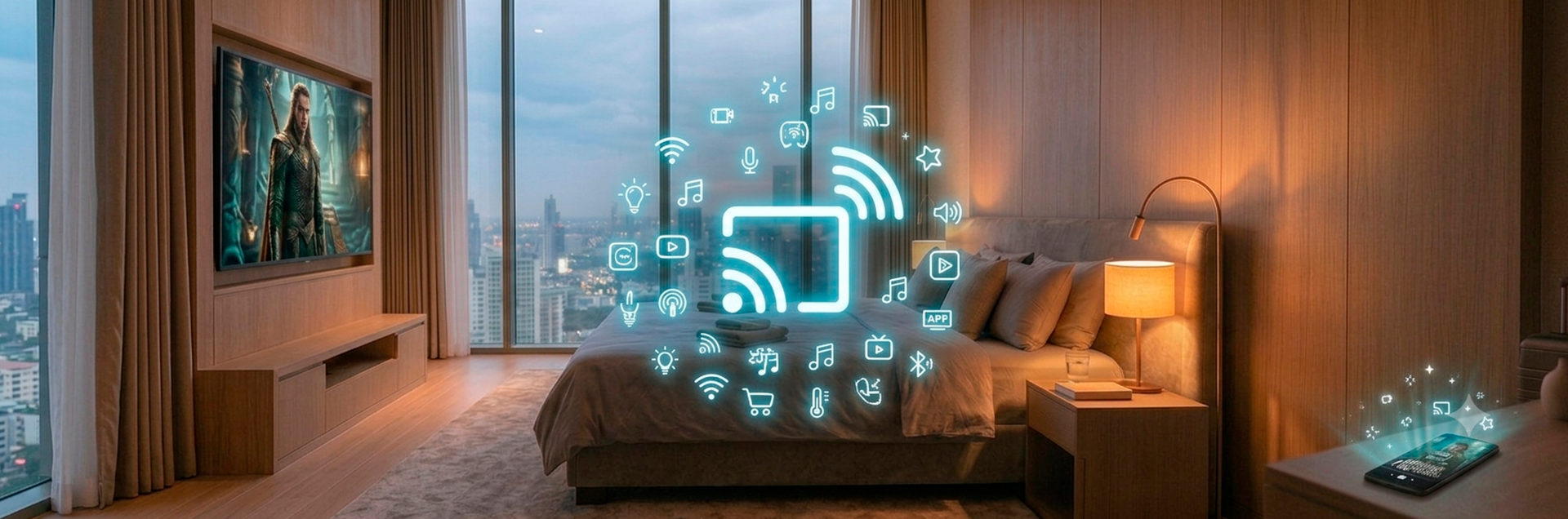
Casting technology bridges this gap elegantly. Rather than requiring hotels to subscribe to dozens of streaming platforms or manage complex licensing arrangements, casting solutions allow guests to mirror their own accounts directly to the in-room TV. They bring their content. The hotel provides the screen and the seamless connection. When the guest checks out, the session clears automatically- no stored credentials, no privacy concerns.
Modern hospitality smart TVs from leading brands are engineered with this workflow in mind. They support casting natively, integrate with property management systems, and can be configured to display hotel information, local guides, and brand messaging alongside entertainment options, turning the TV into a communication channel, not just a content display.
The Hybrid Approach: Where the Industry is Heading
Forward-thinking properties are moving away from the either/or framework entirely. The most competitive hotel entertainment setups today combine a reliable satellite TV backbone for live and linear content with casting capability for guests who want to stream from their own accounts.
This approach serves multiple guest profiles at once. The business traveler who wants CNN at 6 AM and the leisure guest who wants to finish a series on a streaming platform they already pay for are both accommodated, without the property bearing the cost of maintaining every streaming subscription or the technical burden of managing individual logins at scale.
The technology to execute this hybrid model exists right now. The barrier for most properties isn’t availability; it’s knowing where to start and how to structure the investment.
Making the Decision for Your Property
The right entertainment configuration depends on factors specific to your property: your guest mix, your current infrastructure, your contract cycle, and your competitive positioning in your market.
A limited-service property with high turnover and a business-traveler-heavy guest profile may prioritize simplicity and live content. A full-service resort competing on experience may invest more heavily in casting and premium display hardware as a differentiator. The answers aren’t the same for every operator, but the conversation is the same for all of them.
At AdcommTV, we work with hospitality properties across the country to design entertainment configurations that make sense for their specific environment. Whether that means a DIRECTV bulk agreement, a casting-enabled TV upgrade, or a full in-room technology refresh, our team can help you assess what you have, what your guests expect, and what the right path forward looks like.